


A rectangle body shape means your bust, waist and hips measure about the same width, with a waist that curves in only slightly, creating a straight, balanced silhouette. It is one of the most common shapes, and if you are still working out what your body shape is, the steps below will help you confirm it. Then you can choose cuts that either define your waist or celebrate your clean, straight lines.
Quick answer
Quick answer: A rectangle body shape has a bust, waist and hips of similar width and little waist definition. Dress it by adding shape at the waist, volume at the shoulders or hips, or by leaning into sleek, minimalist lines.
- Your waist is typically less than 25% smaller than your bust and hips.
- Wrap dresses, peplum tops, belted coats and high-waisted flares create gentle curves.
- Texture, ruffles and color blocking add dimension where you want it.
- Boxy, shapeless pieces and dropped waists tend to flatten your outline.
- Straight figures also suit tailored, androgynous and column looks beautifully.
What Is a Rectangle Body Shape?
A rectangle body shape, also called a straight or athletic silhouette, is a figure where the shoulders, bust and hips are close in width and the waist is only slightly narrower. The overall outline runs fairly straight from underarm to hip, so weight tends to distribute evenly rather than collecting in one area.
This shape shows up in every height, age and size. A petite woman, a tall woman and a plus-size woman can all be rectangles, because the label describes proportions, not weight. Many rectangles have long legs, a flatter seat and slim arms, though not all do.
It is also worth saying clearly: a rectangle is not a problem to fix. It is a versatile frame that handles trends well, from slip dresses to oversized blazers to tailored trousers. Styling is simply a set of choices about the outline you want on a given day.

How to Know If You’re a Rectangle
You are likely a rectangle if your bust and hip measurements are within a few inches of each other and your natural waist measures less than 25% smaller than both. In a mirror, your sides look fairly straight, and belts or fitted waists sit without a strong inward curve.
Measuring Steps
You only need a soft tape measure and a well-fitting bra or bralette.
- Shoulders: Measure around the widest point of your shoulders, with arms relaxed at your sides.
- Bust: Measure around the fullest part of your chest, keeping the tape level across your back.
- Waist: Find your natural waist, the narrowest point above your belly button, and measure without pulling the tape tight.
- Hips: Stand with feet together and measure around the fullest part of your hips and seat.
- Compare: Divide your waist by your bust and by your hips. A result of roughly 0.75 or higher for both, with bust and hips within about 5% of each other, points to a rectangle.
Treat this as a rule of thumb. Bodies change with age, hormones and training, and many women sit between two shapes.
Rectangle vs Inverted Triangle, Apple and Hourglass
The rectangle overlaps with a few shapes, so this table helps you tell them apart.
| Shape | Shoulders/Bust vs Hips | Waist Definition | Main Styling Goal |
|---|---|---|---|
| Rectangle | About equal | Slight | Create or highlight a waist, add dimension |
| Inverted triangle | Shoulders or bust wider | Slight to moderate | Add volume to hips, soften shoulders |
| Apple | About equal or bust fuller | Fuller midsection | Lengthen torso, draw focus to legs and neckline |
| Hourglass | About equal | Strongly defined | Follow and highlight the natural curve |
If your shoulders are noticeably wider than your hips, you may lean inverted triangle. If your midsection is the widest point, apple may be a closer match. And if your hips are clearly wider than your bust and shoulders, read our pear body shape guide.
Styling Goals: Create Curves and Define the Waist
The main styling goal for a rectangle body shape is balance through contrast: narrowing the waist visually while adding shape above or below it. Belts, wrap closures, peplums, ruffles and structured shoulders all work. You can also skip curves entirely and wear sleek, straight lines that flatter a lean frame.
Think in three tools:
- Definition: Belts, seams, wrap ties and darts pull the eye to the waist.
- Volume: Puff sleeves, ruffled necklines, A-line skirts and flared hems add width above or below the middle.
- Dimension: Texture (bouclé, cable knits, pleats), color blocking and strategic contrast create depth on a flatter outline.
Belt Placement by Belt Width
Where you place a belt matters as much as the belt itself.
| Belt Width | Best Placement | Works With |
|---|---|---|
| Skinny (under 1 in.) | Natural waist | Shirt dresses, knit dresses, cardigans |
| Medium (1–2 in.) | Natural waist or just below | Trench coats, high-waisted jeans, blazers |
| Wide/corset (2+ in.) | Natural waist, over layers | Flowy dresses, oversized shirts, long coats |
| Obi or tie belt | Slightly above natural waist | Wrap tops, jumpsuits, petite frames |
Stylist’s tip
Not sure where your waist is? Bend sideways; the crease that forms is your natural waist. Place belts there first, then try one inch higher if you have a short torso.
Best Tops, Necklines and Jackets
The best tops for a rectangle body shape add shape at the shoulders or bust and nip in at the waist. Peplum tops, wrap blouses, ruffled necklines and fitted knits work well, as do cropped and belted jackets. Look for details like gathers, darts, puff sleeves and textured fabric that create soft dimension.
Necklines and Sleeves
A sweetheart neckline, scoop neck or wrap V adds a curved line near the bust. Square necklines frame the collarbones, and boat necks widen the shoulders slightly for balance with a flared skirt. Puff, bishop and ruffled sleeves bring volume up top, while cap sleeves keep things light.
Tops and Knitwear
Peplum tops create an instant waist and flare. Wrap tops and tie-front blouses do the same with a softer feel. In knitwear, choose fitted ribbed sweaters, cropped cardigans that end at the waist, or chunky cable knits tucked into high-waisted bottoms. A front tuck on a looser sweater adds shape without bulk.
Jackets and Coats
Cropped jackets that hit at the natural waist highlight the narrowest point. A belted trench coat is a classic, and wrap coats and peplum blazers work too. Structured shoulders on a blazer add definition, especially worn open over a tucked top. Long straight coats are fine; just belt them or wear a defined outfit underneath.

Best Jeans, Pants and Skirts
For a rectangle body shape, the best bottoms sit high on the waist and add shape through the hip or leg. High-waisted flare, bootcut and wide-leg jeans balance the frame, paperbag pants create a gathered waist, and A-line, tulip and pleated skirts add volume below a defined middle.
Jeans: High-rise flares, bootcuts and curvy-fit styles add a gentle curve. Back pocket details, yokes and contrast stitching add shape to a flatter seat. Straight-leg and skinny jeans work well too when paired with a top that defines the waist. If you love wide legs, see our guide on how to style high-waisted pants for proportion tips.
Pants: Paperbag waists, pleated trousers and belted wide-leg pants add structure. Cargo and utility styles with hip pockets build volume at the lower half.
Skirts: A-line, circle, tiered and pleated midi skirts create a fit-and-flare outline. Pencil skirts work beautifully on rectangles when paired with a peplum top or a tucked blouse and belt, creating clear contrast.
Best Dresses and Jumpsuits
The best dresses for a rectangle body shape define the waist and add shape above or below it. Wrap dresses, belted shirt dresses, fit-and-flare silhouettes and dresses with side cutouts or ruching are reliable choices. Belted jumpsuits and boiler suits with a cinched waist work for the same reason. For a visual rundown of each silhouette, see our guide to the types of dresses.
- Wrap dress: The diagonal tie creates a waist and a curved neckline in one piece.
- Fit-and-flare: A fitted bodice with a full skirt instantly adds curves.
- Belted shirt dress: Easy for work and weekends; add a medium belt at the waist.
- Cutout or ruched dress: Side cutouts and ruching give the illusion of an inward curve.
- Bodycon or slip dress: These show off a lean, straight line; layer a cropped jacket if you want more shape.
- Jumpsuits: Choose belted, wrap-front or tie-waist styles.
Swimwear and Activewear
In swimwear, look for one-pieces with side cutouts, ruching or color-blocked side panels, and bikinis with ruffled tops or high-cut, side-tie bottoms. For activewear, a longline sports bra with a high-waisted legging creates a waist seam, and contrast panels add shape.
What to Avoid
A rectangle body shape can wear almost anything, but a few cuts tend to flatten the outline. Boxy, shapeless tops worn untucked, dropped-waist dresses, very straight shift dresses without a belt, and heavy, stiff fabrics that fall straight from shoulder to hem can make the frame look blocky.
Do
- Tuck, half-tuck or belt looser tops at the natural waist.
- Add texture, ruffles or color blocking for dimension.
- Choose high-rise bottoms with shape at the hip or hem.
- Try a peplum, wrap or fit-and-flare silhouette.
Don’t
- Wear boxy tunics and oversized sweaters with no waist definition.
- Rely on dropped-waist dresses that move the focus down.
- Pair very straight tops with very straight bottoms in one dark color, unless you want a column look.
- Choose stiff, heavy fabrics that hide your shape entirely.
These are guidelines, not rules. A minimalist column outfit, like a long knit dress or a tonal trouser suit, can look striking on a straight figure. The difference is intention: clean, tailored and well-fitted rather than baggy and unstructured.
Rectangle Body Shape Outfit Ideas
Rectangle body shape outfits work best when they pair one waist-defining element with one shape-adding element. Use the formulas below for casual days, the office and evenings out, then swap colors and fabrics to suit your wardrobe. Each outfit balances the straight frame without needing anything fussy.
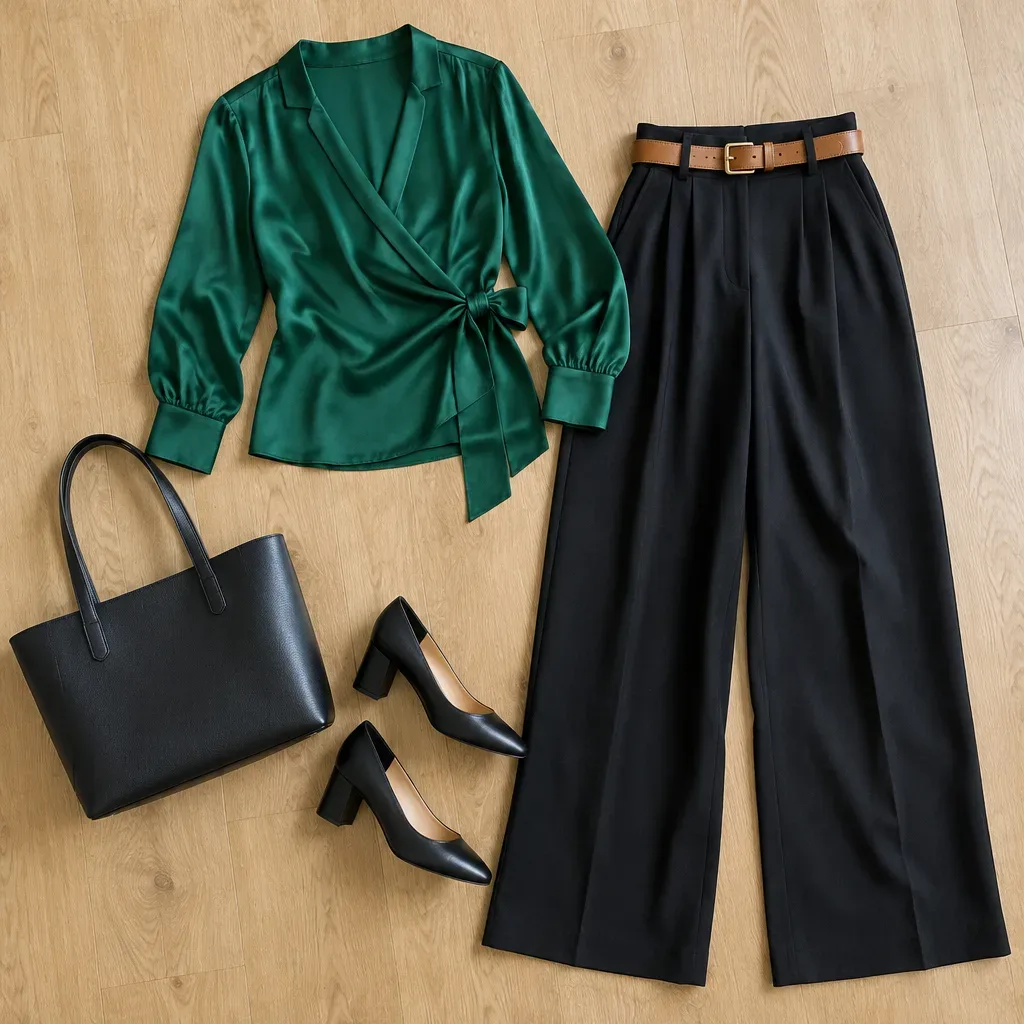
Casual
- Ribbed fitted tee + high-waisted flare jeans + cropped denim jacket + platform sneakers.
- Ruffled-sleeve blouse, front-tucked + paperbag shorts + woven belt + sandals.
- Chunky cable-knit sweater, half-tucked + straight jeans + belted trench + loafers.
Work
- Peplum top + pencil skirt + pointed pumps + structured tote.
- Wrap blouse + pleated wide-leg trousers + belted blazer + block heels.
- Belted shirt dress + cropped cardigan + ankle boots.
Evening
- Satin wrap dress + strappy heels + small clutch.
- Corset-style top + A-line midi skirt + slingbacks.
- Belted tuxedo jumpsuit + statement earrings + metallic sandals.
Embracing a Straight Silhouette
Not every outfit has to create curves. Rectangles look sharp in androgynous and minimalist styles: oversized blazers over slip dresses, tailored trouser suits, column knit dresses and boyfriend jeans with crisp white shirts. Keep the fit clean at the shoulders and hem and let the long lines do the work. For red-carpet proof, see our roundup of rectangle body shape celebrities.
Stylist’s tip
For a minimalist look, wear one color head to toe and vary the texture, such as a ribbed knit with wool trousers. The tonal column elongates while the texture keeps it from looking flat.
Rectangle Shape With a Tummy
If you have a rectangle shape with a fuller tummy, focus definition just under the bust or at the high waist, and choose fabrics that skim rather than cling. Empire seams, wrap dresses, structured jackets worn open and V-necklines create shape without drawing attention to the midsection.
- Empire and wrap styles: These define the narrowest point, which may sit higher than the natural waist.
- Open layers: An unbuttoned blazer or long cardigan creates vertical lines.
- Mid- to high-rise bottoms with a flat front: Choose comfortable waistbands and stretch denim.
- Soft belts: Tie belts and wide elastic belts are more comfortable than stiff leather.
The same principles apply to plus-size rectangles. Prioritize structure at the shoulders, a defined high waist and flowing fabrics such as crepe, jersey and soft denim. Fit and comfort always come first.
Frequently asked questions
What body type is a rectangle shape?
A rectangle body shape is a figure where the bust, waist and hips are roughly the same width, with a waist that is only slightly narrower. The silhouette looks fairly straight from the shoulders to the hips, and it appears across all heights, ages and sizes, since it describes proportion rather than weight.
Is a rectangle a good body shape?
Yes. No body shape is better than another, and the rectangle is one of the most versatile. It suits tailored, minimalist and androgynous looks, works with many trends, and can easily take on curves with belts, wraps and peplums. Styling is about the outline you choose, not about correcting your body.
What should a rectangle body shape avoid?
A rectangle body shape usually looks best avoiding boxy, shapeless tops worn untucked, dropped-waist dresses and stiff fabrics that hang straight with no definition. These hide the waist and can make the frame look blocky. A deliberate, tailored column look is the exception, since clean lines read as polished rather than shapeless.
What jeans are best for a rectangle body shape?
High-waisted flare, bootcut and wide-leg jeans are great choices because they define the waist and add shape toward the hem. Curvy-fit cuts and styles with back pocket details or yokes add dimension at the seat. Straight and skinny jeans also work when paired with a tucked or waist-defining top.
How do I create a waist with a rectangle shape?
Create a waist by belting dresses, coats and loose tops at your natural waist, choosing wrap and peplum styles, and adding volume above or below the middle. Puff sleeves, ruffled necklines and A-line skirts make the waist look narrower by contrast. Side cutouts and ruching also add the illusion of curves.
Can a rectangle body shape wear bodycon dresses?
Yes. Bodycon dresses show off a lean, straight line, and many rectangles love how sleek they look. To add curves, choose versions with ruching, side cutouts or color-blocked side panels. You can also layer a cropped jacket or add a belt to break up the silhouette and define the waist.


